Tuesday, April 7, 2009

Tweeting in the Spring

So I was just reading someone else's blog and then thought "Wow, it's been a while since I looked at my own blog". A whole month actually. Time flies when you're... buried in work.

The past month has been a little hectic (that's an understatement). Outstanding in the Field's 2009 North American tour schedule came out on March 20th, the first day of Spring. The weeks leading up were intense: confirming guest chefs and farm sites for the schedule, putting together the information for the website, setting up our new reservations system... This year we had our act together enough to pre-release the schedule for viewing for two days prior to when the tickets went on sale. That gave people the opportunity to look at the schedule, call their family/friends and make plans before the mad dash on March 20th. We had a list of the dinners on the schedule, but then I also updated our Dinner Map to include the upcoming 2009 dinners. It's a pretty amazing visual- we're going all over the place this summer! Jim and I sometimes joke that the whole point of Outstanding in the Field at this point is to make that map look really good. How cool is it that we added that Montana dot? And the Missouri dot! We put together 54 dinners all together, including 10 new states that we've never even been to before. AND we're going to Ontario! That's pretty exciting for me at least. Unfortunately Montreal never did come together (that chef likes to play hard to get with me!) But we'll definitely still be stopping in Montreal to say hello and show my American workmates La Banquisse poutine!

Anyways, so our reservations page went live at 9 am PST/12 noon EST on March 20th. There were so many people trying to access the site at once it was having a hard time handling it all. That and then the reservations system didn't function exactly as *ahem* planned. Let's just say it involved me barking out each reservation to Jim and Caleb who were tallying like madmen. This was reminiscent of last year for me, but last time I was by myself in my little apartment in Montreal.


It's a little small and maybe hard to make out, but that's the tally count for the tickets as they sold for the 2008 Outstanding in the Field season. Little did we know that we'd get slammed with reservations and 9 events would sell out in the first day.

We eventually found out it was a pretty silly little mistake to do with the taxes that caused the problem this year (ah taxes). The guy who installed the system on our website obviously felt horrible about the whole situation. Live and learn. Next year everything will run perfectly, I'm sure of it this time! We'll also be sure to upgrade the website so it will be able to handle 10,000 visiting the site all at once trying to make their reservations and/or just watching the fun (you know who you are).


So about tweeting. Not sure how many of you have heard of Twitter? It's the latest social networking craze. And I signed up. I know, shocking. Me being the one who is so anti-Facebook. But this is slightly different because I've sort of signed up for work purposes. Twitter is this service that allows you to send out your status message/thought of the moment to the world at any given point. The interface is very simple and you're really only supposed to answer the question "What are you doing?" in 140 characters (that characters, not words) or less. You can send your message through the website, from your phone as a text message, from an iPhone app, or from a desktop application. Of course there's also the whole aspect of "following" and "followers". So I wasted a good deal of time on Sunday perusing the online community of Twitter and finding food/farm-related people to "follow". I was actually surprised with how few people I came across. It is definitely in the process of catching on. Many of the "people" I ended up signing up to follow are actually blog sites, news sites or organizations that are using Twitter as a way to keep in constant touch with their followers. For example Eater, New York Times Dining, epicurious. Ultimately, this is what a lot of people are using it for though. Celebrities, chefs, farmers, organizations- it's like a cheap advertising tool. For example, Nate Appleman, a San Francisco chef tweets "Lamb burger is back at SPQR. Get it while you can. It goes great with a side of chix nuggets". It's really a simplified way to blog. I'm still not sure if it's going to take off as well as something like Facebook, but I kind of like it. It's much less involved too: tell them your name, a short "bio" (also only 160 characters), add a profile photo and if you're really into it you can change you background on your page. That's about it.
I think it'll be really great to keep the excitement around the farm dinners this season, as I know people are always interested to hear about our travels along the way. As much as we try to blog, this will be a lot more easy to keep up with. And of course if you don't hear from me here on this blog for another month you can always check out my Twitter page.


Saturday, March 7, 2009

Vancouver Visit via Seattle

Here's a good thing about the current state of the economy: cheap flights. Since I arrived here in Santa Cruz from Peru over a month ago and decided to stay, I've been itching to go back to Vancouver to get a few things. Mostly some more clothing items (getting kind of tired of the same 4 shirts) and my beloved bicycle. But especially my bicycle.

When I saw flights to Seattle for $79 each way and knew I could get a cheap car rental through Priceline.com, I couldn't resist. The total of the car rental and flight was just under $300. Not bad considering a return flight directly to Vancouver would have been $480. And this way I would also have a car to buzz around Vancity for a few days.

The stop in Seattle actually worked out quite well because I was also able to visit a potential farm dinner chef there that afternoon. We already had the interest of Tamara Murphy of Brasa (the "pig lady of Seattle") and so I was just stopping in that day to discuss details and hopefully confirm her participation. She's recently taken over the cafe under the Elliot Bay Book Company, a fairly iconic bookstore in Seattle. The cafe had evolved into a sad-looking soup kitchen of late and Tamara wanted to revitalize the place. I hadn't seen the place before, but it's definitely looking wonderful now. The old brick walls have an interesting story as well: they used to be above ground. This was a history lesson for me, but apparently Seattle was actually elevated after a devestating fire in the late 1800s. It's kind of hard to explain, so take a look at the story here and/or at wikipedia. Tamara and I had a great time chatting and visiting for over two hours. She was enthusiastic about Outstanding in the Field and participating since it lined up so well with her great support of the local Seattle-area farmers. She also does a really interesting annual event herself called Burning Beast (a big meat-fest collaboration by Seattle chefs) and has a very informative "Life of a Pig" blog on her website. Hence Pig Lady. Anyways, it seemed like everything was set for her doing a July 15th event with us in the Seattle area, but then she emailed me a few days later saying she'd forgotten about the plans she'd already made to leave town that week. Unfortunate, but I'm glad I was able to get to know her a bit better anyways. I'm sure she'll be on the schedule sometime in the future.

It was a quick but fun weekend in Vancouver, complete with an evening of beer and good food at Stella's with Jordan, dinner at Abigail's Party and shenanigans with Colleen, a good walk around UBC and down to the beach with Jordan and Duke, a visit to the Winter Market at Wise Hall, a Salmon Armian disco-funk party and of course gathering of my things and bicycle from "storage" in White Rock.


Hiking down at Spanish Banks near UBC
with Jordan, Duke and the other dogs and people


How could I forget, I also had the pleasure of hanging out the LUSH factory one morning with Jordan, who is now the new manager of the bubble room. He even has his own sticker now- check it out!

Yay Jordan!


So just like that and I'm back in Santa Cruz again. I've been working on some home improvements lately, which I'll share with you soon.

Thursday, February 19, 2009

It's sunny in the wintertime

Look what I went and did- got you all excited about a blog that I was going to keep up to date and then went and disappeared. I'll try and work on it.

So I'm still in Santa Cruz and have actually now decided to stay here for the winter. My original plan was to head up to the North to live with my brother Conor and his wife Shawna, but after being here for a couple of weeks, I just decided to stay. And besides, who goes to Canada for the winter? Especially when you can go to the beach in California instead?


Ocean Beach in San Francisco on Super Bowl Sunday


Tshirt weather I like

Workaholic

Outstanding in the Field work is back in full swing now. We've got an ambitious 2009 schedule in the works and I've been spending the last couple of weeks contacting various chefs and farms across the country, asking them to be involved in our farm dinners this year. This year has been much much easier to put everything together. It definitely helps that I've done it once before and am a bit more confident in my communication, etc. but also because we are working with more than a couple of the people we know from last year. So instead of writing a long email saying "Hello... this is what Outstanding in the Field is all about... we've been all of these places, done lots of dinners with great chefs... you should too!" I can just write "Hi friend, how's 2009 treating you? Want to do a farm dinner again? Great- see you then!" Much easier. Less convincing involved. Although it still is great getting new people on board. I spoke on the phone today with a really wonderful sounding chef from Atlanta (Southern accents are so enchanting!) who didn't really know much about Outstanding in the Field. So I gave him the whole schpeel and by the end he was totally excited and impressed. Yay!


Zumba!

In an attempt to stay sane while working this year, I've been trying to take at least one day off a week and making sure I get out and about to have some fun. I also joined a local gym and have found my new favourite exercise class: Zumba! It is a latin/hip-hop fusion aerobics dance class. Some may recall the days in Vancouver when I was taking Latin Funk classes at Kits Workout (I tended to talk about it a lot!) and I've definitely been missing Tuesday and Thursdays with Gustavo. Zumba could never be as amazing as Latin Funk, but it sure is good fun, and you definitely feel it the next day! And of course I also love it for the good latin tunes! Check out this video to get a taste of Zumba.


Elephant Seals

One day a couple of weeks ago Jim and I went up the coast in hopes of seeing some elephant seals. Thousands of elephant seals come to this one area north of Santa Cruz once a year to mate and it's turned into quite the attraction. Now the parks dept regulate how many people go on the beach everyday and you have to buy advanced tickets to gain access. Jim and I decided to drive further up the coast, park, and then take a leisurely walk a mile or so down the beach to where the seals are (and we may or may not have been allowed to go). It was a really beautiful day, so the walk was nice. I wasn't really sure what to expect, so when we got to an area of the beach covered in these massive lumps that looked like huge logs, how was I supposed to know they were all seals?


So where are the seals?


See them now?


Not actually a log, but a few hundred pound animal!


See the people silhouettes in the first two photos there? Well lucky for us those weren't park rangers, but just scientists out observing the seals. They gave us a polite warning that if the ranger was to catch us out on this particular beach, which was closed to the public (what signs?) we could get hundreds of dollars in fines. With that, we carried on our way, back to where we came from.
We hadn't got too close to the seals, also because it isn't really that safe to do so. I have a hard time believing those huge lumps can move too quickly, but apparently they can. We saw a few move around and they sort of move like worms, "inching" along (metre by metre).

We safely crossed back over to the public area without sighting a ranger. But soon after we did encounter someone else:


A lonely elephant seal on the beach!


It was pretty amazing to get this closer up look of the animal. He was fully facing us too, so we could be a little more confident with anticipating any movement. Take a look at this, they really do look just like elephants, without the ears!


Jim thought that this was one of the juvenile males that wasn't involved in the whole mating process this time around. Apparently the full-sized males can get up to 6,000 lb. and be 16 feet long. I'm not sure I'd want to run into one of those guys at the beach...


Sunday, January 25, 2009

Home Sweet Santa Cruz

Home is a relative term for me these days. I consider myself to have about 5 homes these days: Santa Cruz, Montreal, Salmon Arm, Vancouver and Smithers. I sometimes also like to joke that The Thompson Hotel in the Lower East Side, NYC is my home, since between September and November last year I stayed there 3 separate times for at least 4 days at a time. I'm about due for a visit back I think- the new restaurant, Shang (headed by big name Toronto chef Susur Lee), just opened last month and I'm eager to go check it out.

Anyways, since leaving Peru I've returned "home" to Santa Cruz, CA, where the company I work for, Outstanding in the Field, is based. One of the reasons I originally went to Peru was to get away. Yes, it is hard to get away when you're always away... you have to choose somewhere where you can really give the illusion that you're off the edge of the world, like in Peru. There's no way they have internet and cellphones there.... right? Turns out they do, but at least when you say you're in South America, people don't expect you to be in touch. Last year was busy, really busy, with OITF. I pretty much worked nonstop from May onwards, and the four months prior to that I was going to school at McGill as well as planning our dinner tour. I needed a break, to say the least. But now I'm back and refreshed and ready to get going... starting Monday.

For those of you that might not know so much about Outstanding in the Field, I wrote this little description about it as well as how I originally became involved.


Outstanding in the Field

About 4 years ago I met Outstanding in the Field at the UBC Farm, when I was then working at the Saturday morning Farm Market. Responding to an email sent out by the volunteer coordinator at the farm, I had signed up to help out at the dinner event that was happening one Sunday evening in August. It was a gorgeous event and I had a lot of fun working with the California crew who put these events on all across the country. Jim Denevan is the founder of the company, a some sort of quote “mysterious, handsome Californian artist/chef” who had been devoting himself to his cause since 1999. Katy Oursler was the coordinator/manager of the team, a charming girl with great farm dinner dresses and a welcoming smile. That first year there were three other team members, including a bus driver, a front of the house manager and a dishwasher. It was quite the crew, to say the least, but I was totally enamoured with them all.

It would be a full year until I would see the group again, and although there had been a few staff changes, I still had a great time helping out at the 2006 event. Once again, we set a long table next to the rows of flowers in the field at the UBC Farm. Chef David Hawksworth then of West Restaurant, cooked a delicious 5 course meal, mostly following the “100 mile diet”, and of course paired with local BC wines. The fisherman, cheesemaker, winemaker and UBC Farmers all joined the guests at the table as well, sharing their stories about where the ingredients came from and how they were produced. It was a very educational dining experience! The most fun part for the staff was hanging around the campfire in the field after finishing the cleanup, enjoying the leftover food and wine and hearing the stories of the Californian travelers. Who wouldn’t want to travel around doing this all summer? Happy guests, beautiful farms, fantastic chefs and delicious food and wine… sign me up! So after I graduated with my Biochemistry degree from UBC, I began harrassing Katy to take me on tour for the summer of 2007. I had to put that education to good use! Katy was hesitant since I didn’t have any restaurant/serving experience whatsoever, but with my looong list of prior, highly diverse and random jobs (see the right side bar of this blog) and my persistent emails, I managed to convince her otherwise. In June of 2007, my friends and I gave our notice at “the MacDonald House”, our Vancouver home on 23rd and MacDonald St for the past two and a half years. I packed up my little room and stored some boxes in my friend Colleen’s parent’s basement, then headed off to California to enlist in Outstanding in the Field for the summer. We did 16 events that summer: 14 public events and 2 private. We went all over California, up to Vancouver, across the USA and back from June until October. Relative to our 2008 schedule, this seems like peanuts now, but it was still pretty tiring, a lot of work, but really fun and rewarding. I was hooked. That summer was Katy’s 4th year of traveling across the country, planning the events and managing the tour. It had been hard times, pioneering the “farm dinners”, convincing people that it would be fun and interesting to eat local food in the field. The 2007 tour was the first one that came very close to selling out, as the popularity of local eating and “knowing your farmers” and finally boomed. After that year, Katy was willing to step aside for the upcoming 2008 season and let someone else take the ropes. Being the obsessive organizational enthusiast I am, I was happy to step in. And now here I am! I’ve recovered from our somewhat traumatizing, overambitious 2008 tour of 37 events across the country and am more than satisfied with how everything turned out. It was a very successful and inspiring season. We had over 6,000 guests and greatly increased our “portfolio” of farmers and chefs across the country. I was fortunate to be communcating with some of the best chefs across America: Bill Telepan, Nate Appleman, Paul Virant, Lachlan Patterson, Mary Dumont, and on....

The sky is our limit, that’s for sure. And Jim and I are definitely testing that theory with our 2009 schedule planning.

I’ll save repeating myself and direct you to the Outstanding in the Field website and blog. Jim and I work on the blog together while we’re on tour. We’re a pretty good team: he’s full of ideas and I articulate them well. We polish off each entry together and post it for our readers. We have almost 20,000 people on our mailing list and a pretty broad “fanbase”, essentially all over the world. It’s exciting to think of all of the people reading our stories! Also be sure to take a look at our Dinner Site History Map, which shows most of everywhere I (we)’ve been the past couple of years with the dinners. It also includes the sites of the dinners that date back to 1999, which I of course didn’t participate in.

As I implied earlier, I have signed up for OITF Season 2009. We’re working out the details right now: a 60+ dinner tour? Maybe. We’re not sure how the current economic situation is going to influence us at this point. But we’re ready for more adventure and getting more people out to the farm.

Check out these photos to give you a taste...


New York City Community Garden Dinner
photo by Andrea Wyner


Wisconsin Cattle Ranch Pickup Truck


My other home, the Outstanding Bus
in a Minnesota field


Gearing up for Chicago deep dish pizza in the Windy City


The OITF table in a Community Garden
in Hollywood, CA


Hanging out on the beach in Miami
after an early October event


Our table with the statue of David
in Florence, Italy


And the list of adventures goes on... visit the OITF blog for the stories!

Friday, January 23, 2009

Last day in Lima

Throughout my trip I've been very fortunate to have Gean Carlo's family's house as my home base in Lima. On the 19th, I took an early bus back across the border to Peru, returned to Puno, went out to the airport in Juliaca and then flew back to Lima. It was so nice to be greeted by the family, all excited to hear about my journeys since I'd left over a week before.


Aaron was particularly excited to see his "Tia Leah" (Aunt Leah)
and play with her camera

That evening we just hung around the house and I shared photos and stories. The next day, which was ultimately my last day in Peru, Emily (Gean Carlo's daughter) and I went off to the beach at Miraflores. We had been to Miraflores before with Gean Carlo, but hadn't ventured down to the beach. One of my favourite parts of this day was taking a minibus across town. I still don't have any idea how this system works (and Emily wasn't really able to explain it either), but it did get us there and was very entertaining along the way. The constant yelling and advertising of the "doorman" who was hanging out the side of the van, along with the various patrons of the bus, all contributed to my amusement.


El Beso statue in El Parque de Amor, Miraflores
The Kiss Statue in The Love Park, Miraflores


The beach in Lima


The fancy Marriott Hotel overlooking the Pacific Ocean and the beach


We hung out on the beach for a little while, enjoying some ice cream and the occasional bit of sunshine. When it was time to ascend back to Miraflores, Emily insisted we take the path that was fenced off and stated "Peligro" (Dangerous). There were a few people doing the same so we knew it was passable, but we couldn't really see the condition of the path past half way up. Sure enough, the stairs were there, but a lot of the way they were covered with rocks, which had obviously slid off the side of the hill and deemed the trail unsafe. Emily struggled up the path in her flip flops, but we did finally make it to the top.


A little sweaty after our hike up the hillside


Beach View

Next we went back over to Parque Union and bought a few final touristy mementos for me and then went to the grocery store. I had told Gean Carlo's mother Teresa that I would make dinner for everyone that night, so Emily and I had to go get the cooking supplies. Chinese food, or chifa, is very common around Peru, so I thought I'd try making them some Japanese food: yakisoba. It's a pretty simple stirfry of cabbage, carrots, bok choy, peppers, tofu, ginger, noodles and a few other things. I managed to find everything I needed, including "tofu cheese", as it was labeled. Dinner was a success and fun to prepare and enjoy with everyone. I even got Aaron to help out with peeling the garlic, keeping the work area tidy and helping to put things in the pot. It was reminiscent of my days of teaching the Boys Cooking Club in Vancouver- so fun.

That evening Juan (Gean Carlo's father) arranged for someone down the street to come and pick me up the next morning at about 5:00 am to take me to the airport for my 7:30 am flight back to the USA. Sure enough, he still had to go knock on the guy's door the next morning at about 5:15 to wake him up... Nina, Emily and Juan were all up bright and early to see me off to the airport. Teresa had already assured me in conversation the night before, when I was explaining to her the various "homes" I had in Vancouver, Santa Cruz, Salmon Arm and Montreal, that this could be my home in Peru. What a wonderful family.

Time to get back to my not-so-real real life....


Tuesday, January 20, 2009

Isla Del Sol, Bolivia

I’d read really nice things about the Bolivian side of Lake Titicaca. The largest island is called Isla del Sol and is the birthplace of the Incan sun god Inti. It’s supposed to have amazing views and sunsets as well as a great network of hiking paths. Since my flight was scheduled to go back to Lima on the 19th from Puno, I had just the right amount of time to make the trip to Copacabana in Bolivia and spend one night on the island. And besides, my new passport needs some more stamps, other than just crossing back and forth from the States a bunch of times. On Saturday morning, the day after visiting Los Uros and Taquile, Tim and I caught the bus at 7:30 am to make the trip East. Tim was heading straight to La Paz, Bolivia, but it was the same bus.

Crossing borders over land is always interesting. Go into this building, get a stamp, walk 100 metres, get another stamp, sometimes even a third, then get back on the bus. Much like moving cattle.

Stamp 1: Exiting Peru


Stamp 2: Entering Bolivia


And a pit stop in between, if needed


Shortly after crossing the border, we arrived in Copacabana- the gateway to the Bolivian side of Lake Titicaca. I sorted out my return ticket to Puno, grabbed a bite to eat and then had to head straight to the dock to catch the last boat over to Isla del Sol at 1:30 pm. There were about 3 boats all leaving at that time and it turns out that I picked the right one. Once we got out of the bay, the driver put down a second 40 hp motor and we “sped” ahead of the other boats. It still took well over an hour to arrive to the island, and I really had no idea what was waiting for me: a LOT of stairs heading up to Yumani, the main village on the south side of the island. A lot of stairs, high altitude, huge backpack, yeah- fun. It didn’t help that there were all of these little, well-acclimatized boys nipping at my heels asking to carry my bag and show me to a hostel.


Is there an escalator somewhere...?


These were really the only few days of my trip that I had to figure out on the fly since before I was making trips from Lima and then everything was organized in Cusco. I didn’t have a guidebook so I took a few pictures of pages in Tim’s guidebook, but I still didn’t really have any concept of the size of this village or what to expect in terms of hostels. If I climb higher, do I get a better hostel, a better view? I passed one nice looking place, walked another 5 minutes and then just turned around and went back to it. Eighty bolivianos for the night, a private room, private bathroom. The conversion rate is about 6 or 7 bolivianos to $1 USD. Twelve dollars, I’ll take it. Yes, there were other rooms that cost about $3, but my budget isn’t that tight. I’ll leave those for the travellers who stretching out their funds for another 3 months and take my quiet room.

Despite sleeping well the night before I was still pretty sleepy. I took a short nap (in my nice quiet room) and then set out to climb the rest of the way up the island. Turns out I was on the east side of the island and had to climb to the top to catch the sunset. The hillside was already dotted with other people and I found a nice quiet spot for myself to sit and enjoy. Unfortunately, it was pretty cloudy and the colours were somewhat dulled, but you still got a wonderful sense of being alive from being there, watching the orange and purple sky turn to dark. I grabbed some dinner (more trout) before retiring to my room for the evening.


The next morning I woke up at 8:30 am, which I think is the biggest sleep in I’ve experienced the whole time I’ve been in Peru. No taxi horns here, no one announcing that they’re selling things outside your window and definitely no car noise. Unfortunately, it was raining and I wasn’t able to set out walking until about 10 am, after catching breakfast downstairs.

The island was much quieter now than yesterday when the boats had dropped off about 150 people all at once. The majority of people had got back onto the boat to go back to Copacabana that night, or had continued onto the North end of the island. Who knows where everyone else was, but I only met local people on the paths for the next 4 hours that I spent walking around and sitting and enjoying the sites. There was a pretty amazing network of sometimes stone, sometimes dirt paths all over the island. Most had been well worn by local people moving their small herds of sheep, pigs or cows (or any combination of those animals!) or transporting things by mule. In the more populated areas, kids played on the paths or in the fields. I chatted with two small children named Karem and Arthuro for a while who were playing with their 6 month old llama named Domingo. The llama was about the same size as they were and it was almost like their pet dog as they rolled around in the grass with it. When you come across kids on the roads here they have only a few things to say to you, unless you ask otherwise: one is if you have caramelos (candies) and the other is if you want to take a picture of them (after which they expect a tip). I was trying to wrap my head around the concept that when these poor children see white people they only expect candy or money. And if you refuse, they quickly carry onto the next person. A few are more curious and ask where you’re from. I wonder if they have any idea where Canada is on a map- have they even ever seen a map…? It would be pretty facsinating to stay on one of these little islands for a while and get a better idea of what their lives are really like.

Two children watching over their mule


Here are some other views around the island:


The llamas also get to enjoy the views


Potato fields


Tending the animals on the countryside


Stunning


Nuzzling mules


Return to Copacabana

After a wonderfully relaxing day wandering the island, I hopped the boat back to the mainland and Copacabana to spend the night there. I was pretty surprised to find that many of the hostels near the water were full. There was one a little higher up, but still overlooking the bay that turned out to be a good deal and very comfortable, so I settled on that for the night.


Leaving and looking back at La Isla del Sol


The Copacabana harbour


The view from my Copacabana hostel, La Cupula

Finally Getting to Puno: Lake Titicaca

So before I mentioned the troubles I had in getting to Puno the first time (see this post), which involved a road closure and returning to Cusco. A Kiwi guy named Tim and I ended up teaming together and figuring the next bus we could possible take was overnight to Puno. We visited one bus company and the boy told us that the bus would leave at 11 pm and arrive in Puno about 5:30 am. I got his phone number so that we could call before coming out to the bus station and be sure the highway was open again and the bus was leaving. That’s the day I spent bumming around Cusco visiting a few museums. Tim and I went for dinner and then back to the hostel we had stashed our bags at for the day to call the bus company. I called about 10:15 pm and asked if the bus was still going to leave at 11 pm. “Yes, the bus is leaving at 10:30 pm” is the answer I get. What? I clearly had it written down on this piece of paper that it was leaving at 11 pm, but now the guy insisted that it was leaving at 10:30 pm. “Are you coming to the station?” he asks. “Well, we’re going to try!”

We threw our backpacks into a taxi and sped off to the bus station. I left Tim to carry in the backpacks and pay the cab when we arrived and I dashed into the station. Tim’s Spanish is pretty minimal, so it was best I run ahead. Sure enough the bus was getting ready to leave and unfortunately it was also full. I guess everyone else had gotten the right information. The girls at the counter were speaking quickly between eachother and then made a suggestion to me that we could take a taxi somewhere to catch another bus. I wasn’t sure if I was understanding. Either we were catching up with a bus that had left the station earlier or we were going to a different station to catch a bus that was also leaving soon. They were speaking really quickly and were on and off the phone with whom I assume was the driver of the other bus. There were definitely two empty “cama” (bed) seats available on that bus. Tim comes hobbling in under the weight of both of our huge backpacks as I’m paying for our tickets and then we are rushed out the door to another taxi to take us to another bus. We’re still not entirely sure what’s going on but the girl told the taxi driver where to go, so we were in his hands. Of course he then chooses this time to announce he’s going to be charging us way too much for the ride, to which we protest but have to agree as we don’t have any other choice. I insist that he at least goes quickly. And quickly he does. One of those situations where you think about “it’s a good thing Mom can’t see this happening right now”. The driver erratically drove down the road and about 10 minutes later announces “San Luis!” as we pass a (our) bus. Sure enough, it had left the station about 30 minutes earlier and we had caught up to it! The taxi driver passed the bus and then dropped us off at a random bus stop about 5 minutes ahead. We were now in the San Jeronimo neighbourhood of Cusco, not a lot of tourists here! We waited for what seemed like too long, but finally the bus showed up. We flagged it down and got on. Talk about adrenaline rush! I wasn’t really sure what was happening there, but somehow it worked out. It took me a while to calm down and fall asleep… although Tim managed to do so right away.


Exploring Lake Titicaca

When we got of the bus there were people ready to maul us and convince us to go on their Lake Titicaca tour that day. One thing about tourism in Peru is that the companies are quite aggressive. A representative is always right there when you get off the bus/plane to set you up with a place to stay and as many tours as you’re willing to do. It’s somewhat useful, but if you have no idea of what to expect or look for you also don’t know if you’re getting ripped off. I had looked into the day tours of Lake Titicaca a little before leaving so I knew that they could cost $15 to $30, depending on whether lunch was included, etc. Sure enough, one man latched onto Tim and I and even went so far as to ride in the taxi with us to the hostel. The package he was offering included a visit to Uros Floating Islands and then to a natural island called Taquile, pick up and drop off at the hostel and a bilingual guide for the trip. All of that for 35 soles (3 soles ~ $1 USD, so about $12 USD). There would be a stop for lunch, but that would be paid separately. I thought it was a pretty good deal. Tim was hesitant. He’s traveled to a lot of different countries and is a little more wary about being ripped off. It seems like you have to worry a little less about that sort of thing in Peru (like the guy isn’t going to just take our money and run) and so I figured we should take the deal. Money exchange, paper signing and Luis was off to find his next victim. All this and it was still only 5:45 am. We had time for about an hour of restless sleep in the hostel living room until our pick up time.

Los Uros

Our boat left the Puno harbour at about 7:30 am and headed straight for Los Uros, the Floating Islands. There were about 25 people on our boat, mostly older, but a few groups about my age. The boat was slow, but it was nice to take in the scenery of the island. Lake Titicaca is the “highest navigable island in the world” (although I’ve read there may be higher ones in Bolivia and Ecuador). I’m still not entirely sure what they mean by navigable (what lake is unnavigable?) so if you do, let me know. The altitude of Lake Titicaca is 3,810 m and covers an area of 8,550 square km. The deepest point is 283 m. Sixty percent of the lake is in Peru, while 40% of the lake falls within the Bolivian border.

The Floating Islands are a network of about 40 islands and have a population of 2000 people. The islands are actually made up of “totora” reeds and are completely floating! The base is chunks of totora root and then there are layers upon layers of totora reeds on top of the roots to form the island. Every two weeks they have to almost completely rebuild the island because there are parasites in the reeds that break them down. It’s like a constant work in progress. Each island is home to about 10 families and their houses are also made of totora. Their main livelihood is fishing and artisan crafting.

We visited Chumi Island and two men about 6 women and children were there to greet us. The rest of the island’s people were out fishing and/or at school, but these folks had stayed behind today to show us around their place. The president of the island, identifiable by his special toque, gave a short presentation on how the islands are constructed and what life on a floating island was like.

Chumi Floating Island

An intricate tapestry made by one of the women of the island that describes life on the island.
If I had a house, this would definitely be an interesting wall hanging.


Unfortunately, due to the humidity of living on a reed island, many of the older residents suffered from rheumatoid arthritis. The life expectancy for these people was only abot 60 years old and it’s quite likely that they’re unable to walk for the last 5 to 10 years of their life. It was interesting to learn (later on, when we were back in our tour boat) that the population of these islands was diminishing because young adults were moving to the mainland to enjoy a better quality of life. However, another community of islands that does not accept tourism was not experiencing this phenomenon, as the children are not exposed to the outside world in the same way.

We had a chance to wander around and explore their simple but well built living spaces and purchase crafts from the women. The president threw a rope tied to a rock off of the edge of the island and asked us to guess how deep it was (between 5 and 20 metres). I guessed right on at 17 metres deep and won a mini totora boat necklace.

I don’t think she made any of those necklaces,
but she sure was convincing to get people to buy them


There aren’t any electrical lines going out to the islands,
but they do collect solar power to give themselves a few extra hours of light everyday
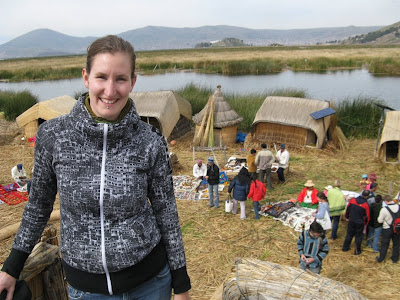


The view from the lookout tower on the island


Neighbouring Floating Island


After the presentation we went on a ride in one of the big matrimonial boats to the island across the way, where we met back up with our tour boat and headed on our way to Taquile.


This matrimonial boat can hold up to 40 people


Waving goodbye to the people on Chumi Island


Taquile

On this natural (hard land, not made of reeds) island, we did a lot of walking. The first ascent definitely has us huffing and puffing up the stairs, again. Seems like a pretty common theme to this week!


More hiking at high altitudes


This is what the paths look like on the island-
of course there are no roads or motorized vehicles


We stopped at a local house that had a nice layout of picnic tables and tents for us to eat lunch.
Lunch was delicious. We started out with my new favourite Andean soup: quinoa soup. Quinoa (pronounced keen-wah) is a grain native to the Andes that I do often eat at home, although had never thought to put in soup. The soup also featured a new-to-me herb called muna that has a fresh minty taste. Next, we got to choose between a tortilla (omelette) or trucha (trout). Tim ordered the trout, so I got the omelette- that way I’d be able to try both! Both dishes were very fresh and tasty. Of course we also had a gorgeous view of the lake, which may have heightened our sesnses a little.


Our lunch table view


Tim and I enjoying our omelette and trout


After lunch we walked up to the main plaza, took a few photos, wandered around, and then headed down the other side of the mountain to the opposite dock, where our tour boat was waiting. The walk along the rock walkways was definitely easier from the top down and we were better able to enjoy the views. What a gorgeous, peaceful spot.


This marker in the main plaza confirmed I was pretty far from home…
6886 km from Montreal and 6302 from NYC


On the island the boys and men knit their own toques and belts.
This little boy is sitting on the steps near the plaza working on a new toque


Heading back down the opposite side of the island to the boat dock


The locals always burn by the tourists on the paths, be it going up or down


On the slow two hour ride back to Puno we enjoyed the sun on the top of the boat and chatted with some Swedish girls who had made their way to Puno via Bolivia. They had done a four day tour of the high altitude salt flats there (another place I definitely want to see at some point) and had some interesting stories. Life is pretty good.